La dotta, la grassa, la rossa. These three adjectives can be regarded as nicknames for Bologna, the largest city in the Emilia-Romagna region.
They relate to the city’s character:
- La dotta – educated, learned, enlightened. This is connected with the world’s oldest university, located in the city.
- La grassa – fat. This refers to the delicious food that originates from Bologna, including mortadella and ragù bolognese.
- La rossa – red. This relates to two features of Bologna. The first, more obvious one is the architecture and the fact that most buildings are built in shades of red. The second, less obvious reason is the left-wing and communist leanings of Bologna’s citizens.
The history of Bologna
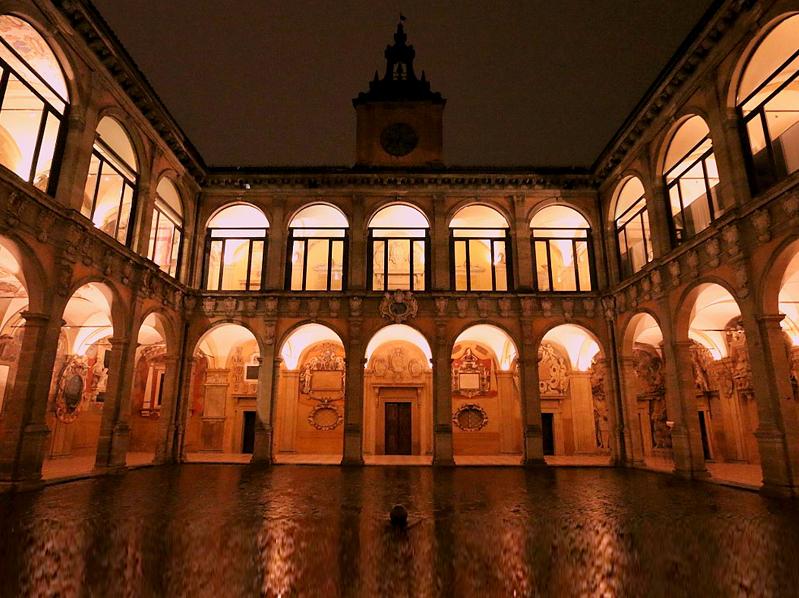
There are several universities in Bologna, but by far the largest of them is the Alma
Mater Studiorum Università di Bologna. This university is considered the oldest university in the world, as it was founded in 1088 (by comparison, most Western universities were founded in the 15th century, with the beginning of the Renaissance).
At first, the university focused on teaching law, as there was very high demand for teaching these subjects in the 11th century. The reason for this was the many conflicts between the Pope and the Roman Emperor, in particular the Investiture Controversy. It did not take long before other subjects were also taught at the university, as a school of medicine was established as early as 1119. It was in Bologna that the world’s first public dissection took place, and in the Archiginnasio palace you can still visit the so-called ‘anatomical theatre’, where all the breakthroughs of the medieval world took place.

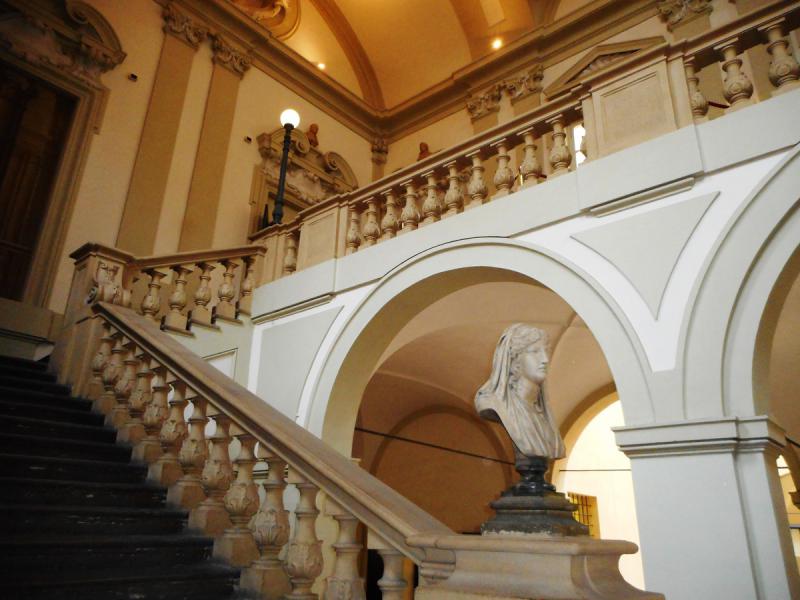
When the institution was founded, Bologna was a very small town; its area did not even cover the whole of today’s ‘old town’. It is no surprise, then, that to this day the vast majority of faculties are located in the very centre. The university’s premises changed as it grew, and today all of them are fully open to students and house museums and libraries.
Many great figures were educated at the University of Bologna, including Nicolaus Copernicus, Guglielmo Marconi, Pope Alexander VI and Francesco Petrarca.
English-taught programmes available at the University of Bologna
As you would expect, the University of Bologna offers most of its programmes in Italian. However, there is a considerable choice of both first-cycle and second-cycle courses. The university has several campuses across the Emilia-Romagna region, so the courses on offer may be held at different campuses. Below you will find a list of first-cycle courses and single-cycle master’s courses, together with the campus where classes take place and the department responsible.
Department of Economics and Management
- Business and economics; Bologna campus
- Business economics; Rimini campus
- Economics and finance; Bologna campus
- Economics of tourism; Rimini campus
- Economics, politics and social sciences; Bologna campus
- Management and economics; Forlì campus
Department of Engineering and Architecture
- Building construction and engineering, Ravenna campus
Department of Medicine
- Medicine and surgery; Bologna campus
Department of Pharmacy and Biotechnology
- Genomics; Bologna campus
- Pharmacy; Rimini campus
Department of Political Sciences
- Economics, politics and social sciences (EPOS); Bologna campus
- European studies; Bologna campus
- International studies; Forlì campus
Department of Sciences
- Biology of human and environmental health; Bologna campus
- Statistical sciences, Bologna campus
Department of Statistics
- Statistical sciences, Bologna campus
In addition, 75 second-cycle courses are available across 14 different faculties. You can find the full list of these programmes on the unibo.it website.
Life in Bologna
Bologna is a medium-sized city with an area of 140.73 km2 and a population of just under 400,000. What is worth noting, however, is that of these 386,000 residents, as many as 93,000 are students, of whom 7,600 are international students (students make up 24% of the population). This has an incredible impact on how the city functions. Amazing nightlife, cuisines from all over the world, and all of it on a student budget. Places that are particularly popular include:
- Pizza Casa, where a whole margherita pizza will cost you just €3
- Delizioso, a place serving Lebanese and Syrian cuisine, where for €5 you can get a delicious falafel wrap
- Cucchiaio d’oro, a bar where the popular Aperol Spritz costs just €2.50
There are also lots of events in the city, which are very easy to find out about on social media.
Geographically, Bologna is very strategically located, and the journey both to Rome and to popular northern cities is relatively short. On a warm weekend you can take a one- or two-day trip to cities such as Venice, Verona, Milan or Parma. It is also very easy to get to the seaside by train, getting off in Rimini or Ravenna. In winter, temperatures drop to around zero degrees Celsius, which is good news for skiers. You can easily get by bus in a short time to the popular Monte Cimone ski resort south of Bologna, or organise a longer trip to the Dolomites.
However, there are also problems you are likely to come across while living in this beautiful city. The housing crisis has hit Bologna very noticeably, and flats are not only expensive but also very hard to come by. Prices for a single room range from €500 to €750 per month, and studio flats from €650 to €1,000. These are, however, hypothetical prices, because you first have to find such an offer. You can look for flats on websites such as Immobiliare or Idealista, and for rooms on Facebook or websites such as Roomless. It is recommended to start searching as early as possible and to get an Italian phone number before contacting the owners of individual flats.